By Myriam Odile Blin
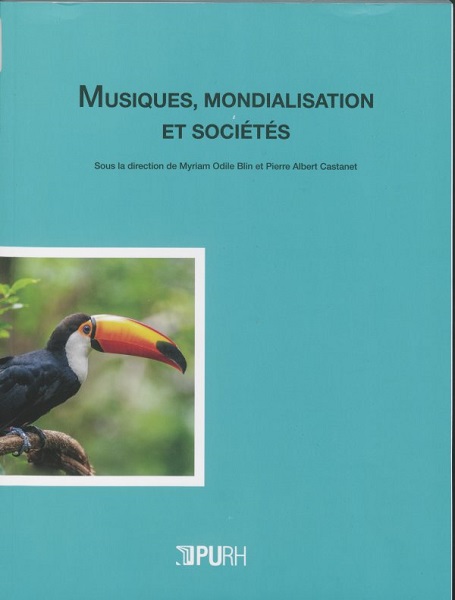
In Musiques, mondialisation et sociétés, under the direction of Myriam Odile Blin and Pierre Albert Castanet, Presses universitaires de Rouen et du Havre, 2024, 250 p.
This book explores the links between music, globalization and society, covering a wide range of themes, including art music, popular music, politics, religion and global cultural issues. Through various articles, it shows how music, in the age of globalization, remains a major vector of cultural mediation, while reflecting the challenges and hopes of our times.
Among the various contributions to this scholarly work is an article by Myriam Odile Blin on Arnold Schoenberg (1874-1951) and his relationship to Judaism. The author focuses on the status of “one Jewish musician in the world,” Arnold Schoenberg, the father of twelve-tone music[1]a musical system based on a series of intervals comprising the twelve notes of the chromatic scale, who was ostracized as a Jew and exiled to the United States in 1933.
 The first half of the twentieth century in Europe oscillated between culture and barbarism, between anti-Semitism and “Entartete Musik”[2]The Nazi term “Entartete Musik” (“Degenerate Music”) refers to a vast repertoire of musical works and composers that were banned under the Third Reich. One of its symbols was the 1938 … Lire la suite, and the Hebraic inspiration of Arnold Schoenberg’s music led to disagreements with Thomas Mann. […] While this singular study naturally evokes such landmark works as Moses and Aron, Jacob’s Ladder and A Survivor of Warsaw, it focuses above all on the Kol Nidrei, the famous introductory tune to the Yom Kippur festival (a melody arranged by Schoenberg in 1938, but also visited by many artists […]. In conclusion, the art sociologist raises the question of music, and Jewish music in particular, as a “conscience of the world” [3]Musiques, mondialisation et sociétés / Under the direction of Myriam Odile Blin and Pierre Albert Castanet, Presses universitaires de Rouen et du Havre, 2024, p. 12.
 Myriam Odile Blin also recalls the writings of André Neher, who considered that Schoenberg’s twelve-tone music drew its inspiration from Jewish mysticism and kabbalah, notably through the symbolism of the numbers 6 and 12, which are very present in Hebrew literature[4]Cf. André Neher, Faust et le Maharal de Prague, le mythe et le réel, Paris, PUF, 1987. Thus, as M-O Blin points out, “the authentic meaning of Schoenberg’s music and writings can only be grasped through the prism of a living spirituality that follows the paths of Jewish mysticism. Yet we can understand twelve-tone music neutrally, without passing through this singular relay of spirituality: it is then a rationally defined writing model for musical composition. […] Arnold Schoenberg was thus inseparably visionary and conservative on the one hand, rational and mystical on the other.” [5]Musiques, mondialisation et sociétés, p. 50.
See Myriam Odile Blin’s lecture « Arnold Schoenberg, un musicien juif dans le monde »
| 1 | a musical system based on a series of intervals comprising the twelve notes of the chromatic scale |
|---|---|
| 2 | The Nazi term “Entartete Musik” (“Degenerate Music”) refers to a vast repertoire of musical works and composers that were banned under the Third Reich. One of its symbols was the 1938 exhibition of the same name in Düsseldorf. See Elise Petit and Bruno Giner’s Entartete Musik: musiques interdites sous le IIIe Reich. |
| 3 | Musiques, mondialisation et sociétés / Under the direction of Myriam Odile Blin and Pierre Albert Castanet, Presses universitaires de Rouen et du Havre, 2024, p. 12 |
| 4 | Cf. André Neher, Faust et le Maharal de Prague, le mythe et le réel, Paris, PUF, 1987 |
| 5 | Musiques, mondialisation et sociétés, p. 50. |