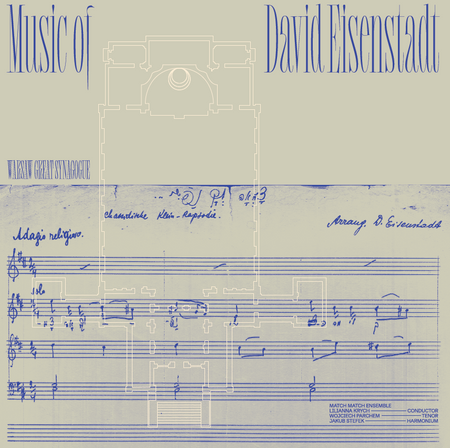
David Eisenstadt (Dawid Ajzensztadt), conductor, educator, and composer, was born in Nasielsk, Poland, in 1890. He was murdered in Treblinka in 1942 after the Nazis liquidated the Warsaw Ghetto. This 33 RPM record, released in 2024, pays tribute to Eisenstadt by reviving some of his works for the first time.
David Eisenstadt
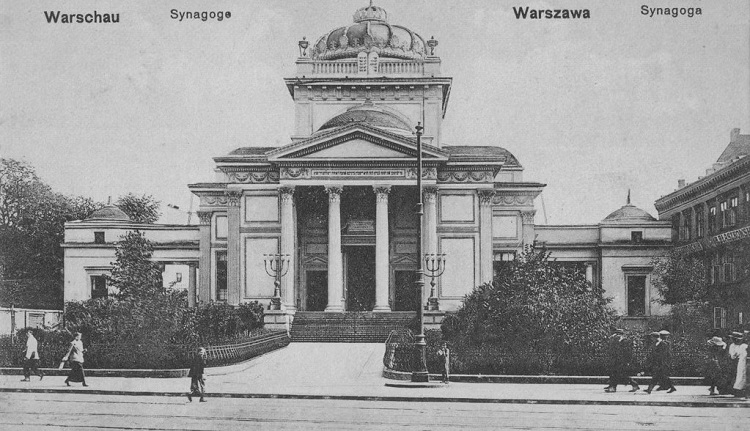
First choirmaster in Berlin, then in Gomel, Riga, and Rostov-on-Don, David Eisenstadt took over as choirmaster of the Great Synagogue of Warsaw (Tłomackie Street) in 1921. In this monumental synagogue, which seated nearly 2,000 people, he conducted a choir of about 80 boys aged 9 to 13 and about 20 men for nearly 20 years.
In addition to religious services, this choir, which quickly gained widespread renown, gave concerts of secular music and recorded for Polish radio. In the Great Synagogue, the choir was accompanied by a harmonium, although many sources also mention the sound of an organ.
In 1935, the choir performed at the world premiere of the opera “Dybuk” by composer Lodovico Rocchi, based on the text by Shalom Anski. This production, praised by music critics, established David Eisenstadt’s position as a promoter of Jewish music. He was also one of the founders of the Jewish Music Society and co-author of the “Algemajner muzik-leksikon,” a series of booklets intended as a Jewish musical encyclopedia. Only the first three issues were published, as the outbreak of war interrupted further publications. In 1936, Eisenstadt became the director of the cantorial school at the Warsaw Music Institute. According to Leon Błaszczyk, he also led choirs for the Society for the Promotion of Jewish Education and Culture (“Szul-Kult”), the Kultur-Lige, and, for a time, the Grossner Choir of the Zionist Bund organization. He composed music for Halpern Leivick’s play “Golem,” which premiered in 1928.
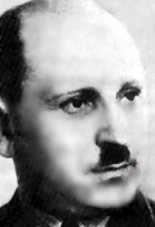
Eisenstadt’s most renowned contribution to the popularization of Jewish music was his annual concerts, attended by Warsaw’s entire musical community. The Eisenstadt home was steeped in European Jewish culture and national Jewish revival. Songs by Schubert, Mendelssohn, and Schumann could be heard there alongside works by Zavel Kwartin and Josele Rosenblatt.
After the German occupation of Warsaw began, Eisenstadt reportedly considered fleeing to the Soviet Union but remained in the capital at his wife’s urging. Life in the ghetto was difficult for the family, but Eisenstadt continued his artistic activitiy. At the Femina Theater on Leszno Street, he founded a symphony orchestra, where his daughter Marysia Ajzensztadt (Miriam Eisenstadt) displayed her full talent. She would later be remembered as the “Nightingale of the Ghetto.”
David Eisenstadt also conducted a synagogue choir when, in May 1941, the German authorities allowed the opening of three synagogues in the ghetto.
The final moments of the Eisenstadt family were described by Jonas Turkow: “When German soldiers separated Miriam from her parents at the Umschlagplatz and forced David Eisenstadt and his wife into a different freight car, Miriam ran back to her parents. She did not want to be apart from them in the final hours of her life. Miriam was already at the car door when a German bullet struck her.” The transport from the Umschlagplatz went to Treblinka, where David and his wife were murdered in the gas chamber.
His works
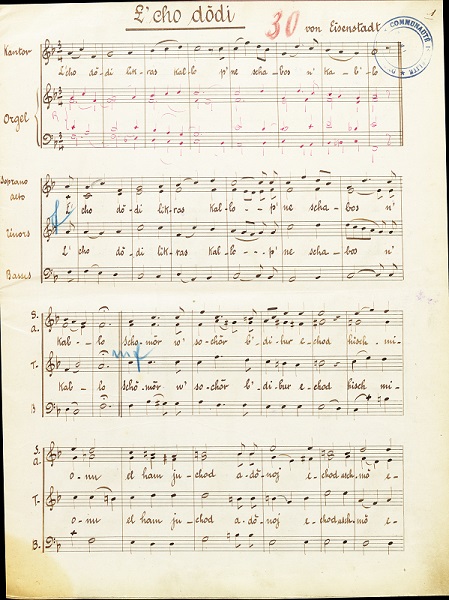
Although it is commonly believed that Eisenstadt’s works did not survive, several of his compositions have indeed been preserved, and new ones are still being discovered. Some were collected and published by Israel Alter, a cantor from Johannesburg, under the title “L’Dovid Mizmor.” These include: “Hajom haras olom,” “L’choh dodi,” “Shom’oh vatismah tsiyon,” “L’eineinu oshku amoleinu,” and “Sh’chuloch achuloh,” composed for either a cantor with keyboard accompaniment or a four-part choir. The cantor’s parts are highly virtuosic, and the equally elaborate instrumental and choral parts reflect the evolution of synagogal musical language during the first half of the 20th century.
These are not the only surviving compositions. In 2011, a manuscript of Eisenstadt’s cantata “Chad Gadya” (One Little Goat), based on the Passover Seder song, was discovered in Cape Town. Eisenstadt had sent it to Froim Spektor, who emigrated to Cape Town in 1928 to become the chief cantor of the New Hebrew Congregation. The cantata consists of four movements: the first is an Allegro scherzando; the second, based on Talmudic motifs, is an Andantino; the third, a Largo, depicts a battle between the Angel of Death and the shochet; the fourth describes the triumph of righteousness over evil.
Other known works include the cantata “Iz awek cum krig der melech” (And the King Went to War), based on a poem by Maria Konopnicka translated by Abraham Reisen, as well as choral songs in Yiddish and synagogue pieces for the Sabbath and holidays. Eisenstadt drew inspiration both from traditional folk styles and well-known oratorio and cantata forms. He also composed orchestral works, including the “Hebrew Suite.” This repertoire remains largely unknown, and it is likely that more of the greatest Jewish composer of Warsaw’s works are still awaiting to be discovered.
This 33 rpm record, Music of David Eisenstadt, initiated by the SPOT.ON ART Foundation, received support from the Ministry of Culture and National Heritage of the Republic of Poland. The Match Match Ensemble, with Wojciech Parchem (tenor solo) and Jakub Stefek (harmonium), is conducted by Lilianna Krych.
Finally, it should be noted that the IEMJ provided two scores by Eisenstadt from its collections for this recording.

Sources:
Learn More about David Eisenstadt
Order the LP or listen to it on YouTube

Listen to extracts below