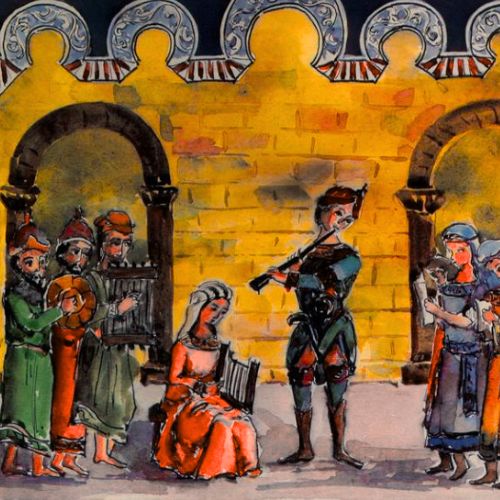
Performed before dawn on Saturday mornings in winter, the singing of baqqashot (or bakashot) represents a rich musical and spiritual tradition. The central legacy of liturgical poetry among Moroccan Jews, this art form has undergone a remarkable revival in recent years.
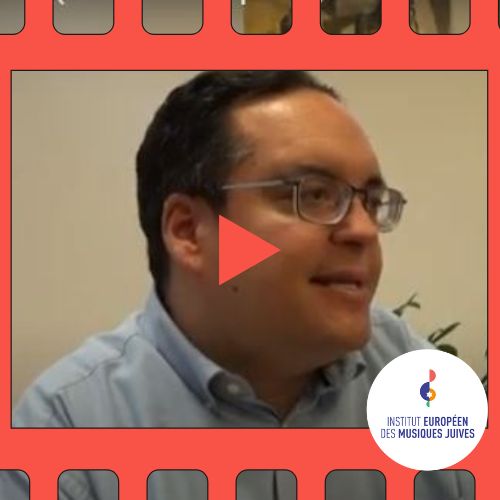
On August 19, 2024, Ariel Danan, paytan [1]Interpreter of religious poetry (piyyutim) and cantor, trained with the greatest masters of this tradition, visited the premises of the European Institute of Jewish Music to retrace the history of this liturgical poetry and give musical examples.
With the participation of Ephraim Kahn, he recorded the baqqashot usually sung at dawn on Saturday, when the parasha Bo[2]The reading of the Torah, the Pentateuch, became the essential moment of synagogal worship from Ezra the Scribe onwards (5th century BC). A pericope is cantilled at the weekly Sabbath morning … Lire la suite, to the Nuba (Andalusian musical mode) Hidjaz El Kbir.
A video recording of this performance was made by Léa Couderc and Ephraïm Kahn, from which the following video was extracted.
Listen to the playlist Discovering baqqashot
| 1 | Interpreter of religious poetry (piyyutim) |
|---|---|
| 2 | The reading of the Torah, the Pentateuch, became the essential moment of synagogal worship from Ezra the Scribe onwards (5th century BC). A pericope is cantilled at the weekly Sabbath morning service, following an annual reading cycle that divides the text into fifty-four parts (each called a parasha). Bo (Come) is the fifteenth parasha in the annual cycle of Torah readings and the third parasha in Sefer Shemot (Book of Exodus) |