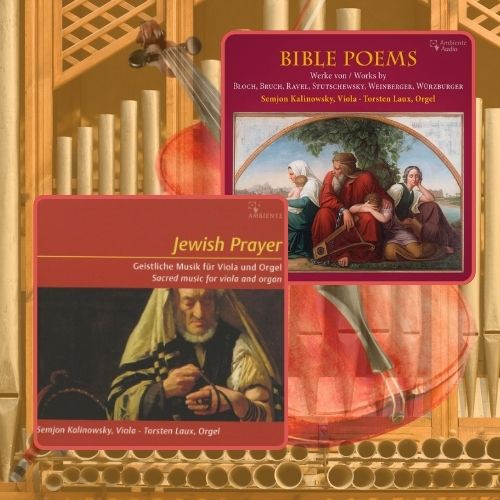
Semjon Kalinowsky, viola – Torsten Laux, organ
The CDs Bible poems and Jewish prayer, released in 2021 and 2012 respectively by Ambiente Audio, invite us to discover – or rediscover – the musical works of some fifteen composers from the 19th and 20th centuries, inspired by Jewish liturgy or the Bible, and written or arranged for viola and organ.
In Jewish tradition, the repertoire for organ and solo instrument is generally quite limited. There are references to the use of the organ at the turn of the 16th and 17th centuries, particularly in Prague. But it was not until the Jewish Enlightenment (the Haskalah) in the 18th and 19th centuries that this quintessentially Christian instrument was introduced into reformed synagogues in Germany (1810 in Seesen), France (1851), and Eastern Europe. Today, the organ is no longer used in the majority of synagogues.
Aware of this fact, violist Semjon Kalinowsky and organist Tosten Laux have revived some pieces from this organ repertoire (works by Louis Lewandowski, Joseph Sulzer, Friedrich Gernsheim, Alain Jehan, Fernand Halphen, etc.) as well as arrangements of well-known works such as Max Bruch’s Kol Nidre, Maurice Ravel’s Kaddish, and Ernest Bloch‘s Prayer. These two CDs also introduce us to lesser-known composers such as Albert Kellermann, Joachim Stutschewsky, Jaromir Weinberger, and Siegfried Würzburger. Torsten Laux also performs two of his own compositions: Meditation and Schalom.
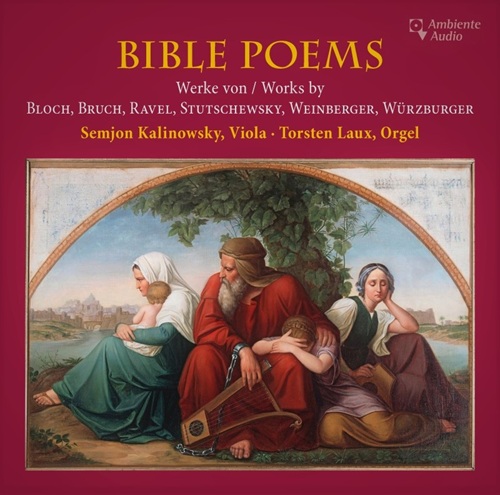

As Musica Sacra (2023 – 4), notes in its review, ‘This CD is the result of Jewish–Christian dialogue. Originally from Ukraine, the violinist Semjon Kalinowsky has lived in Lübeck for many years and is involved in rediscovering the works of Jewish composers. In 2021, he edited Prayer of Remembrance, a collection of organ works by Jewish composers. Bible Poems is his third CD, featuring recordings of pieces for viola and organ. The recording was made on the historic Ibach organ in St Antonius Church in Fleckenberg. Originally built for the synagogue in Aachen [in 1865], the organ did not arrive in Fleckenberg until 1906. This makes it one of only two intact synagogue organs in Germany from the Nazi era. Its structure is still very classical. It shows only the timid beginnings of a ‘romantic’ sound aesthetic. What Torsten Laux manages to draw from this instrument is therefore all the more astonishing. Adopting a symphonic approach, he becomes a magician of sound, captivating listeners from the very first notes. Kalinowski’s viola playing is equally impressive. With a tangy and melancholic sound, he makes the strings sing, creating a remarkable interaction between the two musicians.’
- Learn more or order the Bible Poems CD
- Learn more or order the Jewish prayer CD
- Read the article The organ in the Jewish tradition

Listen to extracts below