
By Hervé Roten
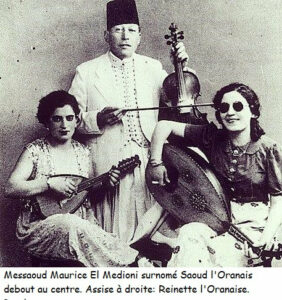
Born on October 18, 1928 in Oran (Algeria), in one of the lively alleys of the derb al yahoud (Jewish quarter), Maurice El Médioni was immersed in oriental café music from his earliest childhood. His uncle, Messaoud Médioni, known as Saoud l’Oranais, ran a café-cabaret where he played violin, composed and sang, and where the singer Sultana Daoud, who later took the pseudonym Reinette l’oranaise, made her debut.
“But music didn’t come to me through him,” Maurice El Médioni would later recount. “My father had died in 1935, when I was 7, and we were four children raised by a mother of meager means. When I was 9, my older brother came back from the flea market with an old piano. It was the happiest day of my life. I loved to sing: Tino Rossi, but also Trenet” (…) “Was the piano difficult? Not at all. “I learned in a week. There was an absolute relationship between my fingers and my brain.” [1]Véronique Mortaigne, “Maurice El Médioni, le piano à l’arabesque”, Le Monde, June 27 2003
As a pianist, Maurice was regularly invited by his school friends to entertain at parties and birthdays. But on November 8, 1942, the Americans landed in North Africa. Gifted with an innate sense for music, improvisation and accompaniment, Maurice, aged just 14, frequented American bars where he was introduced to boogie-woogie and country music alongside African-American and Texan soldiers. He also met Puerto Rican soldiers who taught him the rumba and cha-cha-cha. After the departure of 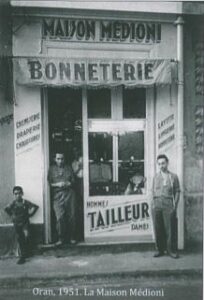 the Americans in 1945, Maurice took up his father’s trade as a tailor, while continuing to perform from time to time in cafés.
One day, around 1947-48, “I was playing at the Café Salvat. Three North Africans passed by, street musicians with derbouka and tambourine. In the evening, we play together. In a few minutes the bar was packed, Arab music had just blended with jazz and cha-cha-cha!“.[2]Véronique Mortaigne, op. cit.
With his musician friends – Hamida Guerbi, Amar Ben Amar and Kaddouri Bensmir – Maurice entertained at the Café Salvat, which was never empty…” Until one day, when musician Blaoui Houari asked him to join the Oriental orchestra of the Oran Opera directed by Mahieddine Bachtarzi. […] At the head of a musical society, the Moutribia, Bachtarzi multiplied exchanges with other Maghreb countries. As a result, Maurice accompanied many Tunisian artists on tour in Algeria. […] In France, I was good friends with Raoul Journo, but we never played together! All the Tunisian musicians in and around Paris were my friends: El Kahlaoui Tounsi, Maurice Meimoun…”[3]Raoul Bellaïche, “Maurice El Médioni, créateur du ‘pianoriental'” – Interview with Maurice El Médioni, Je chante ! Magazine n° 1, January 2016, p. 61

In 1961, Maurice El Médioni left Algeria to emigrate to Israel, where he stayed for a few months before settling in Paris in 1962, where he sometimes played at parties, bar mitzvahs and weddings. In 1967, he decided to return to the Mediterranean sunshine of Marseille, where he opened a clothing store with his brother. Occasionally, at Line Monty‘s express request, he returned to Paris to accompany her on piano.
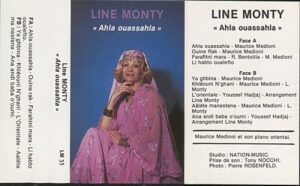
In 1985, he gave up his 42-year career as a tailor to devote himself entirely to music. He performed regularly with Reinette l’Oranaise, Lili Boniche and Blond-Blond, while maintaining close ties with Line Monty.
In the 1990s, Michel Lévy, who had bought the Dounia catalog from El Kahlaoui Tounsi, produced several CDs with Bruno Barre, featuring Lili Boniche, Blond-Blond, Reinette l’Oranaise, Line Monty, Luc Cherki, René Perez… in a collection entitled “Trésors de la chanson judéo-arabe” (Ed. Mélodie Distribution). These CDs, which were later reissued by Buda Musique, brought back into fashion the leading artists of Franco-Arab or Franco-Oriental chanson, sometimes accompanied on piano by Maurice El Médioni or singing his works. In 1992, the opening night of the Montpellier-Danse Festival featured Line Monty, Lili Boniche and Reinette l’Oranaise. Maurice El Médioni’s career took off on stage and in the recording studio. In 1996, the Piranha label released a CD entitled Café Oran – Maurice El Médioni et son PianOriental, on which he played with the Klezmatics. In 2000, he recorded Samaï Andalou – 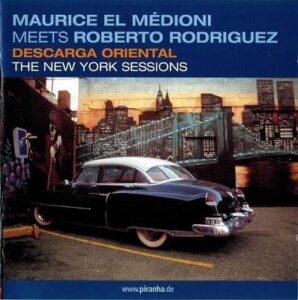 Arab-Cuban Music published by Magda and Pianoriental by Buda Musique. In 2003, he published the CD Liturgie Hebraïca – Andalouse. In 2004, he accompanies Philippe and Jonathan Darmon on the CD Musiques d’hier et de toujours… Grands classiques de la liturgie juive d’Algérie (Editions ESDE). In 2006, he recorded with Cuban percussionist Rodriguez Descarga Oriental: The New York Sessions (Piranha), which won the BBC World Music Award for Culture Crossing in 2007. In 2007, he played in Marseille with the El Gusto orchestra, a group of Jewish and Muslim veterans of Algerian Chaâbi folk music. In March 2010, he performed at the Théâtre du Vieux Colombier (Paris) for the Prix Francine et Antoine Bernheim, under the aegis of the Fondation du Judaïsme Français[4]See the recording of this ceremony on Akadem. In 2012, he appeared in his own role in the Franco-Irish-Algerian documentary El Gusto, produced and directed by Safinez Bousbia. Finally, on January 27, 2013, at the age of 84, he recorded a two-hour live concert at the Musée d’Art et d’Histoire du Judaïsme Oran-Oran, once again published by Buda Musique.
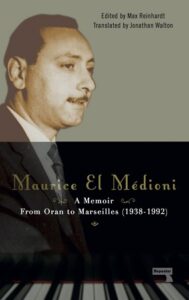 In 2011, Maurice El Médioni moved to Netanya, not far from two of his sons, with his wife, who had serious health problems. He then performed on stages all over the world: Los Angeles, Montreal, Berlin, Moscow… But some time later, lung cancer forced him to slow down the pace of his tours. He then wrote his memoirs in a book entitled Maurice El Médioni, A Memoir: From Oran to Marseille (1936-1990) published in 2017, before moving to a retirement home in Netanya, where he passed away peacefully on Monday March 25, 2024. Right up to the end of his life, Maurice El Médioni and his family never ceased to pass on documents [5]notably to Yvonne Kahan and Ava Bohbot (Chaos Film), who are currently directing a documentary, Notes of Exile, dedicated to Maurice El Médioni. on his incredible career, which marked the synthesis of musical styles thought difficult to reconcile (Oriental, Jazz, Latin America…).
 No doubt that if there is a heaven with a piano, the angels are dancing there to the sound of oriental rumba, under the kind smile of Maurice “the Mediterranean”…
- Consult the Maurice El Médioni archive fonds
- Listen to excerpts from the Oran-Oran CD
- Listen to the playlist Algerian Jewish Song (1)
- Listen to the playlist Algerian Jewish Song (2)
- Buy the comic book and CD Les stars du music’hall d’Algérie by Valérie Cohen and Didier Zuili
| 1 | Véronique Mortaigne, “Maurice El Médioni, le piano à l’arabesque”, Le Monde, June 27 2003 |
|---|---|
| 2 | Véronique Mortaigne, op. cit. |
| 3 | Raoul Bellaïche, “Maurice El Médioni, créateur du ‘pianoriental'” – Interview with Maurice El Médioni, Je chante ! Magazine n° 1, January 2016, p. 61 |
| 4 | See the recording of this ceremony on Akadem |
| 5 | notably to Yvonne Kahan and Ava Bohbot (Chaos Film), who are currently directing a documentary, Notes of Exile, dedicated to Maurice El Médioni. |