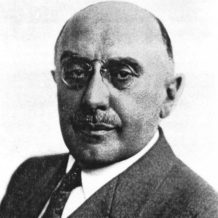
Born in 1879 in Odessa, Jacob Weinberg was a pianist and composer who wrote more than 135 works for the piano and other instruments. Born to a totally-integrated Russian Jewish family, he started his career at seventeen as a bank employee. He resigned rapidly however and left to study the piano and counterpoint at the Imperial Music Conservatory in Moscow. He then began to compose his first instrumental works, which he played during concerts in Saint Petersburg, Kiev and Odessa. In 1905, he travelled to Paris to participate in the Anton Rubinstein Piano Competition. While he did not win the First Prize, his performance contributed to launching his career as a piano virtuoso.
In 1910, he met the composer Joel Engel, a founding member of the Society for Jewish Folk Music, who shared his enthusiasm for Jewish folklore. “It was there that my interest for Jewish things was born,” he later declared. “I took great interest in Jewish music, and I began to collect and study Jewish popular songs. A new and practically unexplored perspective opened before me.”
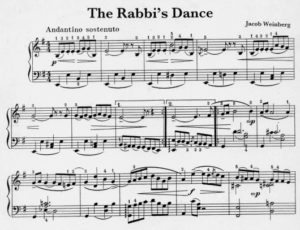 In 1916, Weinberg returned to Odessa to teach at the Imperial Music Conservatory until 1921, date when he emigrated to Palestine where he absorbed oriental modes and melodies, which he then used in his compositions From Jewish Life and Jacob’s Dream. In 1924, he resumed his collaboration with Joel Engel, recently arrived in Palestine from Berlin. However, in 1926―after the success of his opera in Hebrew, Hechalutz (The Pioneers), which won the First Prize in the music contest for the 150th Independence anniversary of the United States―he emigrated to New York where he became actively involved in Jewish intellectual circles as an instructor-researcher, composer and orchestra conductor. There he met up again with several composers from the Society for Jewish Folk Music.
From 1929 onward, Weinberg taught music at the New York College of Music, then at Hunter College. At the beginning of the 1940s, he organized a series of annual festivals of Jewish arts (music and dance) in New York that achieved great success. He also participated in launching several Jewish music festivals in other American cities. He died on November 2, 1956 at the age of seventy-seven form a pulmonary disease.
In addition to individual liturgical arrangements and two biblical cantatas, Isaiah and The Life of Moses, Weinberg wrote three complete Shabbat services, particularly for the Temple Emanu-el in Manhattan, where he was one of the house composers.
Biography from the CD’s booklet Hebrew Melodies for cello and piano, 2nd vol., Collection Classiques vol. 7, Les Editions de l’IEMJ, 2021. Sources: Neil W. Levin, Milken Archive
Browse our archives on Jacob Weinberg
Search for other recordings or scores by Jacob Weinberg