By Isabelle Durin
At the dawn of the 20th century, the rise of antisemitism under Europe’s totalitarian regimes forced countless Jewish families into exile, creating successive waves of migration between the two World Wars. A that time, the United States stood out as a new El Dorado—a promised land where everything seemed possible.
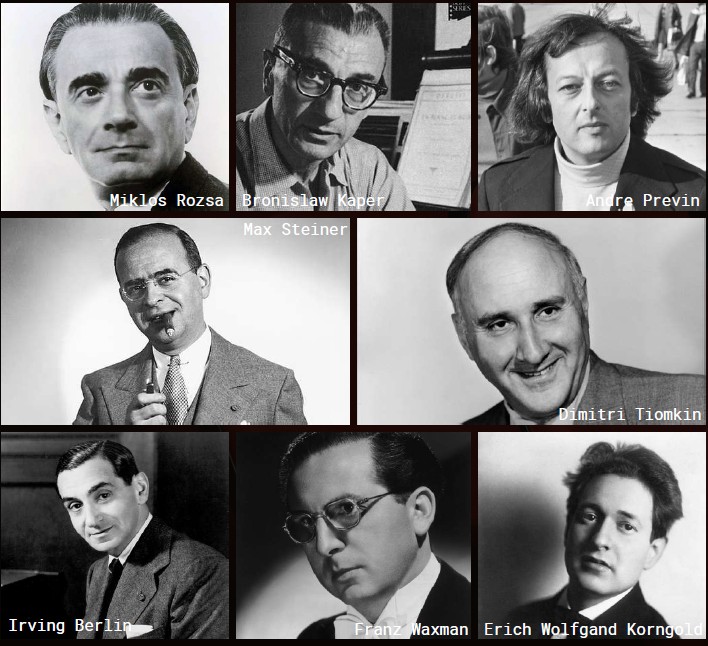
Among these exiles were renowned composers such as the Austrians Max Steiner and Erich Wolfgang Korngold, the Germans Franz Waxman and Andre Previn, the Hungarian Miklós Rózsa, the Pole Bronisław Kaper, the Russian Irving Berlin, and the Ukrainian Dimitri Tiomkin.
Some of them are experiencing this uprooting under circumstances that are sometimes tragic. Waxman, beaten in the street by Nazi stormtroopers in 1934, fled Berlin the very next day. Previn left Germany as a child in 1938, just weeks before Kristallnacht, thanks to the unlikely help of a Nazi officer once defended by his lawyer father. That same year, during the Anschluss, Korngold, already an established composer, happened to be in the United States working with Max Reinhardt on A Midsummer Night’s Dream for Warner Bros. —a contract that quite literally saved his life.
In fact, the ties some composers maintained with friends, directors, or producers—already established in America—often served as a bridge between two worlds: Old Europe on the one hand, and the New World on the other. Tiomkin, for instance, was guided by the advice of Feodor Chaliapin and George Gershwin; Rózsa was invited by Alexander Korda to score The Thief of Bagdad and later The Jungle Book; and Waxman, encouraged by producer Erich Pommer, made his own decisive leap. These encounters exemplify the transition from exile to opportunity.
Hollywood quickly became the place to be for any composer hoping to make a mark. The great studios were busy inventing the dream machine, and cinema offered the ultimate artistic gateway. The arrival of sound—with The Jazz Singer in 1927 (which famously featured Blue Skies) —launched the Golden Age of film, lasting more than three decades.
And Jewish composers in exile, heirs to the Wagner-Mahler-Strauss tradition, would play a major role in this by bringing their expertise in classical music to Hollywood. Korngold and Steiner, both child prodigies and dazzlingly versatile talents, embodied this legacy. Mahler himself had encouraged them as young musicians. Steiner would later joke, with his characteristic wit: “Mahler predicted I’d be one of the greatest composers of all time. He just didn’t know I’d end up at Warner Bros!”
Alongside Waxman, these Viennese composers inherited the grandeur of late-Romantic music, but also broke free from its shadow, inventing what came to be known as the “Hollywood symphonic style”: a blend of Germanic post-Romanticism and the cultural melting pot of America.
In their quest to integrate into American culture, they sought to unify their dual European and American identities. Nearly all turned to jazz, that quintessentially American idiom.
This musical syncretism, this interweaving of stylistic influences, is what gave birth to the sound of the Golden Age, transcending every cinematic genre. Adventure films (The Prince and the Pauper, The Jungle Book), sweeping epics (Ben-Hur, Taras Bulba), romantic sagas (Gone with the Wind, The Brothers Karamazov), musical films (The Jazz Singer, Annie Get Your Gun), film noirs (Dial M for Murder, A Place in the Sun) —each genre demanded constant reinvention, and these composers rose brilliantly to the challenge.
Waxman, with his hybrid and daring style, is emblematic of this artistic synthesis. Steiner as well. Tiomkin, who called himself with humor “a Hollywood Russian,” blended Slavic lyricism with American folk tunes in his westerns. Berlin drew on Yiddish inflections, Rózsa wove Hungarian idioms into his scores, while Previn—perhaps the most fully assimilated emerged as one of the great West Coast jazz pianists, a true one-man orchestra, epitomizing Hollywood’s golden splendor.
All were showered with accolades, including multiple Oscars. Standing at the crossroads between the “old world” and the new, their music became a universal passport.
The generations that followed—Bernard Herrmann, Elmer Bernstein, Jerry Goldsmith, and of course John Williams—built directly on their foundations.
In just three decades (from the 1930s to the 1950s), these émigrés had written their names in gold.
From exile they drew strength; from their Jewish heritage, not a destiny of destruction, as in Europe, but a wellspring of life and creation—in the land of the Happy End.

Source: Exile to Hollywood CD booklet, pp. 2-3
More about the Exile to Hollywood CD
Read Laure Schnapper’s articles:
- « L’ exil des musiciens judéo-allemands aux États-Unis (1933-1944) », Encyclopédie d’histoire numérique de l’Europe [online], ISSN 2677-6588 https://ehne.fr/en/node/12303
- « Cinéastes berlinois et viennois exilés à Hollywood », Encyclopédie d’histoire numérique de l’Europe [online], ISSN 2677-6588 https://ehne.fr/en/node/12216