Ensemble Salomone Rossi
Concerto classic, 2008 / Music.media, 2009
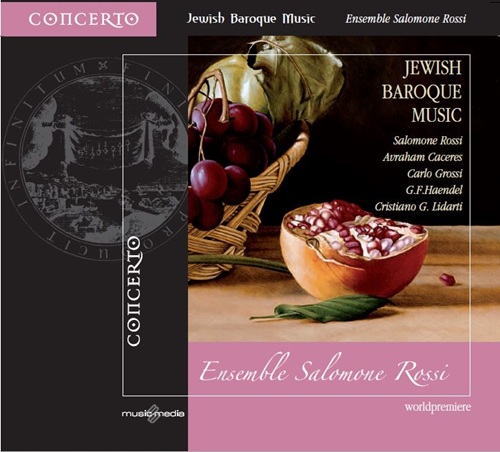
Recorded in 2008 by the Salomone Rossi Ensemble, this CD features a collection of iconic works from the tradition of Jewish Baroque music, first developed in Italy in the 17th century and continued in Amsterdam during the 18th.
Baroque Jewish Music: A Brief Overview
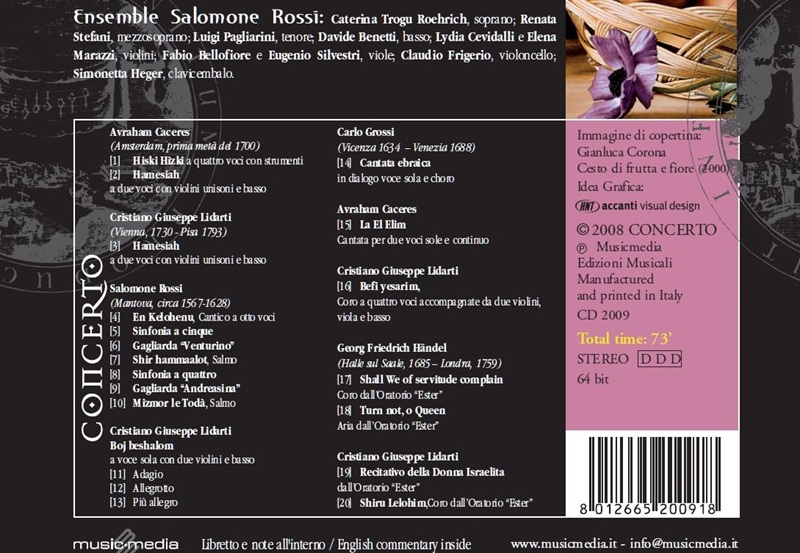
In northern Italy, the Court of the Gonzagas of Mantua welcomed many Jewish musicians during the 16th and 17th centuries. Salamone Rossi (ca 1570 – ca 1630), undoubtedly the most famous among them, worked there until 1612 alongside Claudio Monteverdi (1567–1643). In 1622–23, under the influence of the reformist rabbi Leon of Modena, Salamone Rossi published an important collection in Venice—titled Ha-Shirim asher li-Shelomo (The Canticles of Solomon)—containing 33 choral pieces for 3 to 8 voices intended for synagogue worship and written in the Italian style of the time. This CD features three of these choral works (En Kelohènu, Shir hamaalot, Mizmor le Toda) interspersed with instrumental pieces by Rossi. Also in Italy, the non-Jewish composer Carlo Grossi (1634–1688) wrote a Cantata ebraica in dialogo in 1680 (or 1681) for a Jewish brotherhood in Modena or Venice.
This trend of Jewish assimilation into the surrounding classical music scene was also evident in Amsterdam, where, in the 18th century, wealthy Portuguese Jewish families hosted concerts of operas and cantatas in their salons, genres that even found their way into the synagogue through the works of Abraham Caceres (notably Hiski Hizki and the cantata Le-el Elim of 1738) and Cristiano Giuseppe Lidarti (1730-après 1793). The latter composed the oratorio Ester in 1774, the longest work in the entire history of Baroque Jewish music (over two hours). The libretto for the oratorio Ester was written by the rabbi of Mantua and Venice, Jacob Raphael Saraval (1707?–1782), known for his interest in music. In a document dated March 1757, Saraval asked the authorities of the Mantua ghetto, a few days before Purim, for permission for the students of his Yeshiva to present “a sort of opera based on a biblical story.” He obtained permission on the condition that no non-Jews be admitted to the performance, except for the instrumentalist and the costume designer. Saraval’s libretto is based on the text of the second version of Handel’s oratorio Esther (1732), but with many cuts and a few additions. This dazzling CD references the oratorio by including two excerpts from it.
The Salomone Rossi Ensemble
Founded in 1991 by violinist Lydia Cevidalli, the Salomone Rossi Ensemble features on this CD: Caterina Trogu Roehrich, soprano; Renata Stefani, mezzo-soprano; Luigi Pagliarini, tenor; Davide Benetti, bass; Lydia Cevidalli and Elena Marazzi, violins; Fabio Bellofiore and Eugenio Silvestri, violas; Claudio Frigerio, cello; and Simonetta Heger, harpsichord.
Learn more about the Salomone Rossi Ensemble
See other CDs recorded by the Salomone Rossi Ensemble
Learn more about Lydia Cevidalli