Isabelle Durin & Michaël Ertzscheid
Nomadmusic, May 22, 2026
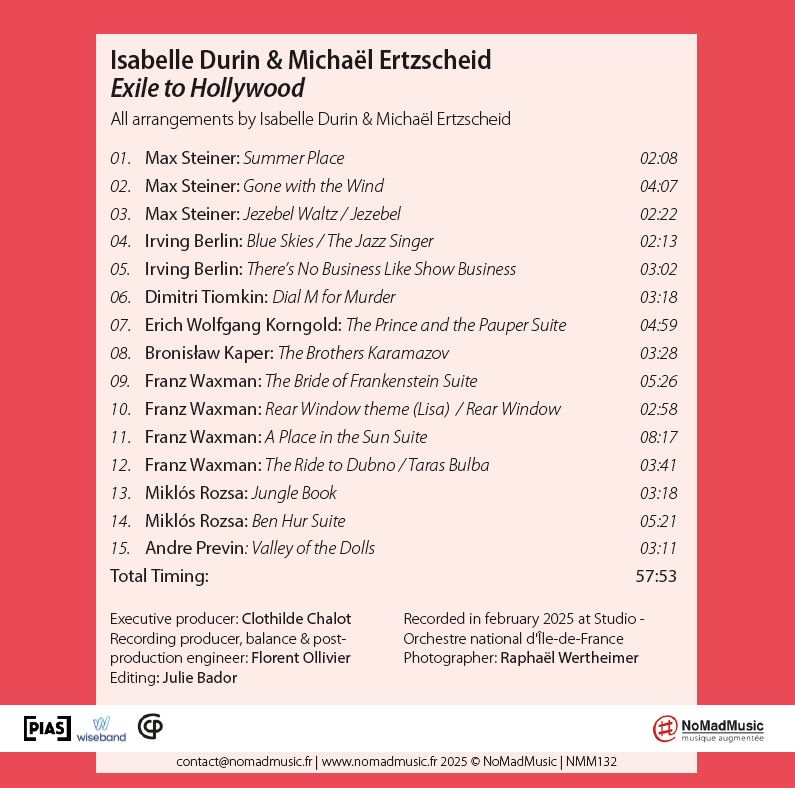
In the early 20th century, the rise of totalitarian regimes in Europe forced nearly 3 million Jews to emigrate to the United States, the new promised land. Among them were many composers—such as the Austrians Max Steiner (1888–1971) and Erich Wolfgang Korngold (1897–1957), the German Franz Waxman (1908–1967), the Hungarian Miklós Rózsa (1907–1995), the Polish Bronisław Kaper, the Russian Irving Berlin, and the Ukrainian Dimitri Tiomkin (1894–1979) – settled on the West Coast and contributed to the rise of Hollywood cinema by bringing their expertise in post-Romantic European music, which they blended with American culture and jazz to create a new style of music that would become emblematic of the greatest Hollywood films (The Jazz Singer (1927), The Prince and the Pauper (1937), Gone With The Wind (1939), Jungle Book (1942), Summer Place (1959), Ben-Hur (1959), etc.).
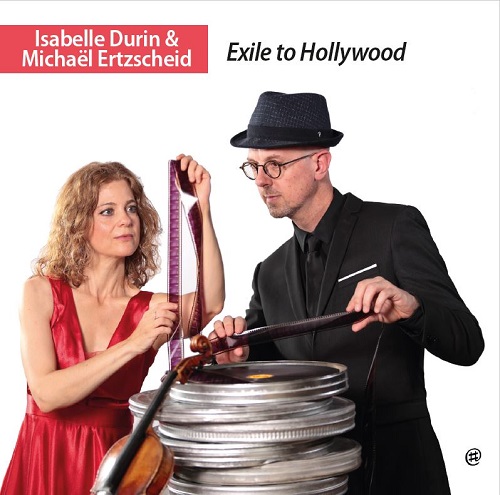
This CD, “Exile to Hollywood,” performed by violinist Isabelle Durin and pianist Michael Ertzscheid, celebrates a music of freedom, cultural fusion, and resilience. It is a vibrant journey to the heart of the Golden Age (1930s–1960s), where exile becomes a source of creativity and brilliance.
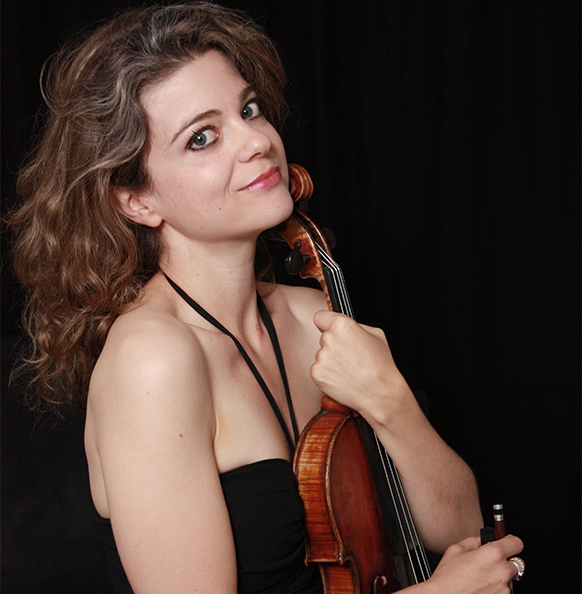
Hervé Roten interviewed Isabelle Durin for the release of this new recording.
HR: Isabelle Durin, what inspired you to produce this album dedicated to Jewish composers of the Golden Age?
ID: In our two previous albums (“Mémoire et Cinéma” and “Un violon dans l’Histoire”), Michaël Ertzscheid and I explored the world of Jewish traditions and the various cinematic portrayals of World War II through its most iconic music. While working on a concert project focused on jazz in cinema, I had put together a program highlighting Bernstein, Mancini, Legrand, and Hurwitz. I had focused in particular on two themes that would sound great on the violin: “Blue Skies” and “The Valley of the Dolls,” composed respectively by Irving Berlin and Andre Previn. After doing some research on their personal histories, I realized they shared a common past: they had both left their respective countries—the Russian Empire for Irving Berlin and Germany for Andre Previn—due to the persecution of Jews. From there, I began researching which composers from that period (the 1920s and 1930s) had left Europe to find refuge in Hollywood. Between Irving Berlin, who marked the beginning of this golden age, and Andre Previn, who, in a way, brought it to a close, I discovered or rediscovered other composers, such as Max Steiner, Erich Wolfgang Korngold, Franz Waxman, Miklós Rózsa, and Dimitri Tiomkin… I listened to their film scores, each one more sublime than the last; I immersed myself in this world where melody is king and imagined all those sounds resonating on the violin and piano. After this extensive research, I narrowed it down to 15 pieces and began working on their arrangements.
First step: a pen and paper when the orchestral score was nowhere to be found! Hours and hours, headphones firmly on my ears, transcribing the different parts and rearranging them for violin and piano! Once I had finished notating the violin part, I sent it to Michaël so he could write or arrange his part. Sometimes we found scores online or piano reductions that helped us with this delicate work—which is more about transcription than arrangement—since our goal was to preserve the integrity of the original score, note for note.
It was a challenging task, but one that allowed us to fully immerse ourselves in the style, playing techniques, nuances, and phrasing of these truly magnificent film scores!
Purchase the CD
Learn more about Isabelle Durin
Learn more about Michaël Ertzscheid