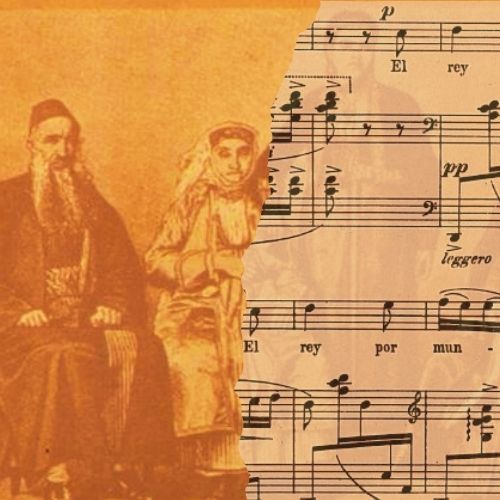
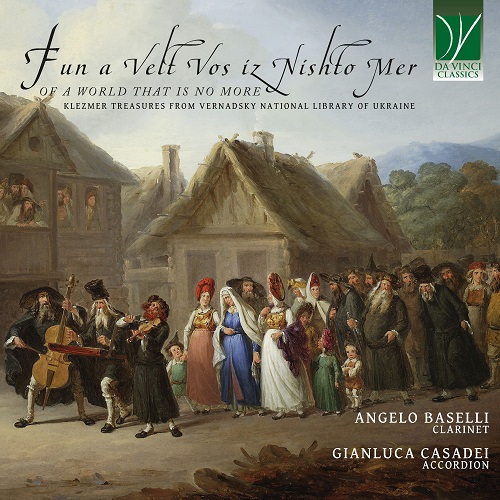
Of a World That Is No More - Klezmer treasures from Vernadsky National Library of Ukraine
Angelo Baselli (Clarinet), Gianluca Casadei (Accordion)
Edition Da Vinci Classics, 2025
Music Of a World That Is No More…
This is the title of the CD performed by clarinetist Angelo Baselli and accordionist Gianluca Casadei. This world is that of the shtetls[1]Literally: small villages or small towns where Jews often lived in dire poverty, alternating between periods of calm and times of hardship (pogroms, famine, destitution…). In these villages, Jewish life was governed by strong traditions rooted in intense religious practice. The Hasidim were particularly prominent in the area, and their melodies (nigunim) were regularly sung. Itinerant musicians (Klezmer) earned a meager living by performing, particularly at weddings. All of these musical practices eventually wove together a tradition unique to the Jews of Eastern Europe.
In 1911, Shalom (Shlomo) An-ski (1863–1920)[2]He is best known as the author of the play The Dibbuk, a classic of Yiddish literature realized that these traditions had begun to fade away. Between 1912 and 1914, he organized two ethnographic expeditions to the shtetls of Volhynia and Podolia, which made it possible to collect tens of thousands of documents of all kinds from more than 70 villages, including over 2,000 folktales and legends, 1,500 folk songs and over 1,000 synagogue and instrumental melodies, hundreds of photographs of synagogues, cemeteries, and other places of Jewish life, not to mention recordings of proverbs, incantations, and other customs emblematic of shtetl life[3]See the article “An-ski: Ethnographic Expedition and Museum” by Benyamin Lukin at https://encyclopedia.yivo.org/article/2074. Several renowned musicians, musicologists, and folklorists, such as Joel Engel and Zusman Kisselgof, participated in these expeditions. These were abruptly interrupted in 1914 with the outbreak of World War I. Some of the collected materials were exhibited at the Jewish Museum in St. Petersburg, which opened briefly in 1917, then again in 1923, before closing permanently in 1929. In 2000, most of the remaining objects were housed at the Russian Museum of Ethnography in Saint Petersburg, while the majority of the manuscripts and audio recordings were held in the Vernadsky National Library of Ukraine in Kyiv.
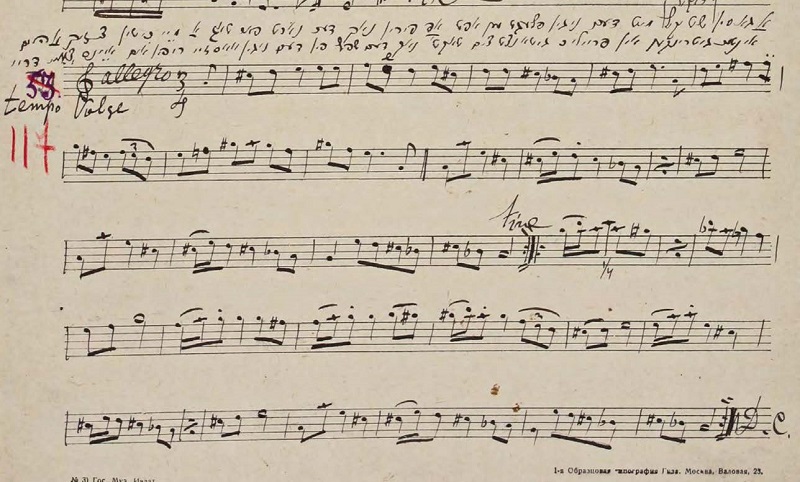
In 2017, a partnership between Tokyo University of the Arts and the Klezmer Institute of New York led to the launch of the Kiselgof-Makonovetsky Digital Manuscript Project (KMDMP). The goal of KMDMP is to make previously unpublished manuscripts from the An-Ski expedition accessible to everyone. This collection consists of two main components: first, the material collected by Kisselgof himself; second, the handwritten anthology of wedding pieces compiled by the violinist-scholar Avraham-Yehoshua Makonovetsky (1879–1941), preserved with Kisselgof’s papers in the Manuscripts Section of the Vernadsky National Library of Ukraine. Enriched with technical annotations and liturgical instructions, these manuscripts are much more than sheet music: they are living documents that bear witness to the practice of klezmer musicians, thereby allowing us to recreate the voices and sounds of a world that no longer exists.
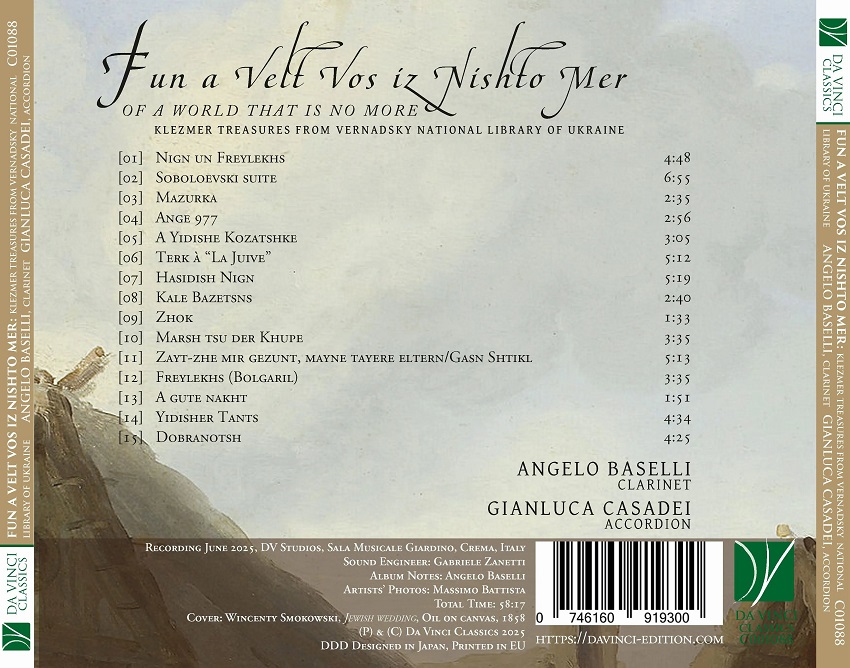
The klezmer music repertoire is extremely broad. It includes synagogue chants, Hasidic melodies, as well as Slavic and Romani folk music. In addition, there is a wider repertoire featuring dances that were popular throughout Europe: quadrilles, Spanish dances, polkas, and waltzes. The CD “Fun a Velt Vos iz Nishto Mer” perfectly illustrates this diversity of styles by featuring 15 tracks, including nigunim, dance suites (Khosidl, Freilekh, Sher, Terkisher…) and European dances (Mazurka, Terkish “à la Juive,” as part of this dance borrows the melody from Fromental Halévy’s opera “La Juive” The second part of the album centers on wedding music, such as “Bazetsn di Kale” sung by the master of ceremonies (the Badkhan) during the bride’s arrival and the start of the ritual, followed by several dances (Zhok, Freylekh, Yidisher Tants…).

A winner of several national and international competitions, Angelo Baselli is an Italian clarinetist who has performed regularly with various chamber music ensembles, symphony orchestras, and opera companies. In addition to his career as a classically trained musician, he has developed a passion for folk music, with a particular interest in klezmer music, a field in which he has led several projects, including the creation of this CD, “Fun a Velt Vos iz Nishto Mer.”
Gianluca Casadei studied classical accordion with Patrizia Angeloni at the O. Respighi Conservatory in Latina, and later jazz with Renzo Ruggieri at the G. Braga Institute in Teramo. He has participated in numerous master classes and performed with many artists, including the Cliff Korman Ensemble, Tinto Penaflor, Paolo Vivaldi, Giuliano Sangiorgi (Negramaro), and Alessandro Mannarino. He has also recorded and composed numerous pieces of music for theater, film, and television. Finally, he has been involved in community projects, notably leading to the production of a CD featuring inmates and professional musicians.
See YouTube videos from the KMDNP Project

| 1 | Literally: small villages or small towns |
|---|---|
| 2 | He is best known as the author of the play The Dibbuk, a classic of Yiddish literature |
| 3 | See the article “An-ski: Ethnographic Expedition and Museum” by Benyamin Lukin at https://encyclopedia.yivo.org/article/2074 |