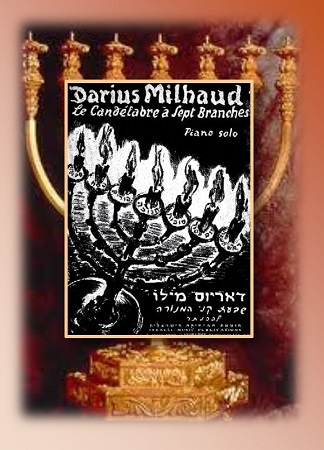
A music score on tracing paper, dedicated to Madame Alice Halphen
By Hervé Roten
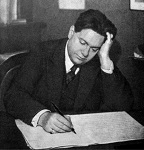 Composed in Paris between December 20 and 28, 1951, Le Candélabre à Sept Branches (opus 315) is a cycle of seven short works for piano by Darius Milhaud (1892-1974), evoking the main celebrations of the Jewish calendar (First day of the year, Day of penance, Feast of Tabernacles, The resistence of Maccabees, Queen Esther’s feast, Passover, Festival of Weeks). This 10 minute long piece of music was performed for the first time on April 10, 1952 by the pianist Frank Pelleg (1910-1968) during Ein Gev festival (Israel). This work, dedicated to Madeleine Milhaud, was published in 1952 by Israeli Music Publisher (Tel-Aviv).
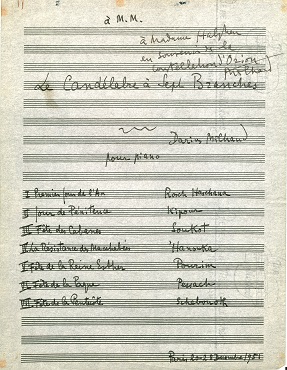 The title of this muscial score is a reference to the seven-branch menorah (candelabra) from Salomon’s Temple. Darius Milhaud belonged to an old Jewish family from the Comtat Venaissin. He never denied his roots. And some parts of his work reveals his attachment to Judaism[1]See Gil Pressnitzer’s article in Esprits Nomades.
Le Candélabre à Sept Branches uses no liturgical of folklorik Jewish themes. The musical language remains the same usually used by the composer. But as the musicologist François-René Tranchefort notices, « the accents of this music are at the same time dark and coloured, warm, intimate and profound.»[[2]François-René Tranchefort, Guide de la musique de piano et clavecin, éd. Fayard 1987 p.529.
The manuscript on printed tracing paper present at the European Institute of Jewish Music comes from the Halphen collection. This unique piece of work features a mysterious inscription by Darius Milhaud « to Madame Halphen in memory of Orion constellation ».
The EIJM possesses other musical scores by Darius Milhaud with Jewish inspiration, such as the 6 Hebraic Popular Songs published by Hegel in 1925, or the operas Esther de Carpentras (1938) and David (1954).
Sources: IRCAM, Musicologie.org, Esprits nomades (Gil Pressnitzer)
- Read Darius Milhaud’s biography
- Listen to the playlist Darius Milhaud and his works inspired by Jewish tradition
- Browse the catalogue of works by Darius Milhaud kept at the EIJM
- See the musical score : Le Candélabre à Sept Branches – Darius Milhaud
- Listen to Le candélabre à sept branches performed by Frank Pelleg
| 1 | See Gil Pressnitzer’s article in Esprits Nomades |
|---|---|
| 2 | François-René Tranchefort, Guide de la musique de piano et clavecin, éd. Fayard 1987 p.529. |