Von Dr. Philippe Olivier
Artikel veröffentlicht auf der Website Résonances lyriques, über die Box Musiques Juives dans le Paris d’après-Guerre (Jüdische Musik im Paris der Nachkriegszeit) und die Arbeit des IEMJ und Hervé Roten zur Erhaltung und Aufwertung jüdischer Musikarchive (ins Englische übersetzt)
Wednesday, February 18, 2026
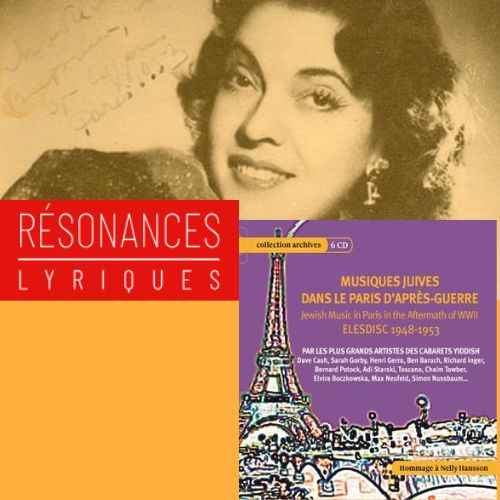
Famous for her Yiddish and Russian performances, Sarah Gorby (c.1900-1980) was fluent in nine languages. – N. N.
A magnificent anthology of Yiddish songs, performed in several Parisian cabarets between 1948 and 1953. Six CDs attest to the links between this music and a musical breeding ground marked by Bártok, Kodály, and Enesco. We are treated to performances by Sarah Gorby, bass Ben Baruch, and other performers brought back to life thanks to the European Institute of Jewish Music
While the President of the Republic is making strong statements against anti-Semitism, I am astonished to learn that the dynamic European Institute of Jewish Music (IEMJ), based in Paris, has been operating for years without receiving a penny of public funding. This situation is all the more surprising given that the team led by Hervé Roten since 2012 has international expertise in this field, recognized by the most renowned specialists. [1]However, the current IEMJ was founded in 2006. Various changes have led to its current status. In other words, the structure has been in place for two decades. Roten himself is a highly qualified ethnomusicologist, having published with Actes Sud[2]Hervé Roten: Musiques liturgiques juives – Parcours et escales, Actes Sud, Arles, 1998. Under his leadership, the IEMJ has built up impressive collections of printed and manuscript scores, remarkable iconographic documents, and recordings.[3]www.iemj.org. This collection illustrates the following three watchwords: preserve, transmit, and promote.
The recordings, precisely. The six-CD box set entitled “Jewish Music in Post-War Paris,” consisting of recordings made between 1948 and 1953 in the capital, does not take its listeners to the synagogue but to the cabarets where Yiddish singers performed, accompanied by often seasoned instrumentalists. It brings together 126 tracks, moving emblems of a world almost entirely destroyed by the bloody madness of Nazi Germany. With around 11 million speakers in 1939, it inspired the poet Isaac Katzenelson (1886-1944) to write his famous “Song of the Murdered Jewish People,” hidden under a tree in the Vittel internment camp. While the writer Isaac Bashevis Singer (1904-1991) won the 1978 Nobel Prize for Literature for all his works written in his mother tongue, Yiddish, we are fortunate to find here a musical equivalent which, relatively speaking, inspires as much respect, admiration, and enthusiasm. This anthology brings together artists who made the evenings and nights beautiful in Paris at cabarets such as La Riviera, the Habibi Club, and Le Zodiac. Most of them were located around the Place de la République. It is important to note that the joy brought by these performers was overshadowed by rivers of tears and insurmountable trauma. The first of these recordings dates back to 1948, three years after the liberation of the Auschwitz extermination camp at the end of January 1945. The oldest dates from 1953, when survivors did not dare to recount their experiences in hell. They feared they would not be believed. Psychoanalyst Régine Waintrater bears witness, in her practice and publications, to the torment of their descendants.
So here we are, discovering a dozen contemporary performers of the tragic events of the Holocaust. Many of us will discover the excellent Sarah Gorby (c. 1900-1980), the amusing Dave Cash (1910-1981), and the moving Ben Baruch (1914-1997), who was also a synagogue cantor like his father and uncle. Their destinies overlapped with a profusion of painful biographies, unfolding across Central Europe, Russia, France, Latin America, and the United States during terrible historical vicissitudes. Many of these voices were not trained in the classical sense of the term. But they displayed remarkable natural talent and a moving freshness. In any case, the bass Ben Baruch was part of a tradition that greatly enriched the world of classical music. The son of a “hazan”[4]This Hebrew word refers to the cantor or officiating minister of a synagogue community. He can be heard during services. like the great composer Kurt Weill (1900-1950), he shared this distinction with Friedrich Schorr (1888-1953) and Neil Schicoff (*1949). The former was the only Jewish Wotan in the history of Bayreuth. [5]George London (1920-1985), born George Burnstein, almost became the second. However, health problems and the death of Wieland Wagner in 1966 prevented him from singing the role of a lifetime for a … Lire la suite The second – trained by his father Sydney Schicoff (1920-1965) and Franco Corelli (1921-2003) – was one of the stars of the Metropolitan Opera in New York. His performances as Werther and Éléazar have gone down in singing history.
The audio journey proposed by Hervé Roten, accompanied by executive producers Eléonore Biezunski and Léa Couderc, is a stroll through places such as Poland, Russia, and Romania. Hungary is not forgotten, as the generous box set includes a Yiddish version of the song “Les feuilles mortes” (Dead Leaves), a masterpiece by Joseph Kosma (1905-1969), recorded in 1951 by Dave Cash. The anthology as a whole combines spoken word, unique tangos, other Latin American rhythms and jazz forms, humorous verses, rhythmic recitation, quotes from “Carmen,” Mozart, and “Le Temps des Cerises,” delicious potpourris, and memories of barbaric acts in which the perverted German of Hitler’s world resounds in a chilling manner. This is “Mort en martyr” (Death as a Martyr), which tells the story of a little boy accused of espionage and burned alive by Nazi soldiers in a synagogue with the members of his community. Henri Gerro (1919-1980) is the interpreter of this deeply moving story. Here, as elsewhere, a sonic expression dominates, revealing, among other things, its proximity to the works of Bartók, Kodály, Enesco, and other masters. The majesty of the violin, the presence of the cimbalom or pan flute and clarinet at various moments affirm a shared cultural family tree. The klezmer tradition enchants. As for the characteristic onomatopoeia of Yiddish folk songs, they flourish.
Hervé Roten’s choices are excellent. They honor the Levantine school of ethnomusicology, embodied by survivors of the Germanic world, prey to Hitler’s madness, such as Edith Gerson-Kiwi (1908-1992) and Israel Adler (1925-2009). The latter, Roten’s teacher, was trained like him at the Conservatoire National Supérieur de Musique, before creating the National Sound Archives of Israel based on the model of the sound library installed at the Bibliothèque Nationale de France. Finally, the anthology compiled at the IEMJ reminds us of a truism: the simultaneous existence of seemingly contradictory modes of musical expression. While people were celebrating gefilte fisch and mocking the tears of a bride-to-be refusing to leave her mother in Parisian cabarets, the Boulez and Leibowitz families—documented in relation to Yiddish theater[6]Michael Schwalb: René Leibowitz-Missionar der Moderne, Text + Kritik, Munich, 2022, p. 41.—were leading their radical aesthetic revolution.
Dr. Philippe Olivier
Link to the box set publication with audio playlist: https://www.iemj.org/reedition-du-coffret-musiques-juives-dans-le-paris-dapres-guerre-elesdisc-1948-1953/
Video link Musiques juives dans le Paris d’après-guerre (Jewish music in post-war Paris): https://www.iemj.org/video-musique-juives-dans-le-paris-dapres-guerre/
| 1 | However, the current IEMJ was founded in 2006. Various changes have led to its current status. In other words, the structure has been in place for two decades. |
|---|---|
| 2 | Hervé Roten: Musiques liturgiques juives – Parcours et escales, Actes Sud, Arles, 1998. |
| 3 | www.iemj.org. |
| 4 | This Hebrew word refers to the cantor or officiating minister of a synagogue community. He can be heard during services. |
| 5 | George London (1920-1985), born George Burnstein, almost became the second. However, health problems and the death of Wieland Wagner in 1966 prevented him from singing the role of a lifetime for a baritone—Wotan—in Bayreuth. |
| 6 | Michael Schwalb: René Leibowitz-Missionar der Moderne, Text + Kritik, Munich, 2022, p. 41. |