By Domenica Foti
Michele Bolaffi (Florence 1768-Livorno 1842) was a Florentine composer of Sephardic Jewish descent. A man of broad cultural interests, his activities spanned music, literature, teaching, and music theory. He was a talented singer (tenor), poet, literary figure, translator of Hebrew texts, vocal and chapel master, accompanying musician, historian, and music theorist. His work includes a wide variety of secular and liturgical compositions.
Musical Career
Bolaffi, himself a singer, often performed in public. He sometimes played the cimbalom on his own compositions, or sang alongside the famous lyric soprano Angelica Catalani. It was to the latter, whose vocal qualities he praised, that he dedicated the sonnet “Stupor tu fosti allor d’Europa intera.”
Among his most prestigious professional positions, he briefly served as music director to the Royal Duke of Cambridge in 1809. Between 1816 and 1818, he was Kapellmeister at the court of Louis XVIII in Paris and held a position at the Théâtre Royal Italien, where he was responsible for reviewing scores.
Pedagogical and academic activities
Bolaffi was a tireless promoter of music education. Around 1819, in Paris, he founded and directed a music school, adopting the “mutual teaching” method of the Italian Federico Massimino, thereby helping to spread Italian style and culture. He also taught music at a mutual teaching school in Marseille.
Between 1821 and 1822, in Florence, he founded two other music schools where he taught singing and conducted the choirs of the Scuole Sante Italiana and the Scuola Levantina. He continued his educational work by opening another music school in Genoa in 1823 and teaching at the private Jewish school Or Torah in Livorno in 1825. Between 1836 and 1837, he was appointed honorary professor of the Jewish community schools.
On the academic front, upon the recommendation of Mr. César de Saluces, he was appointed a member of the Royal Academy of Turin and obtained the position of correspondent for the department of literature and Fine Arts.
Literary works and translations
A man of great culture, Bolaffi corresponded with many prominent figures of the time, including Rossini, the impresario Lanari, and Princess Hélène Baciocchi, Napoleon’s sister.
Most notable translations: Voltaire’s epic poem ”L’Henriade”,…
- Voltaire’s epic poem ”L’Henriade”, in free verse Italian.
- “Teodia o sia Inno filosofico a Dio,” a Hebrew text by Shelomoh ibn Gabirol, translated into Italian.
- “L’immortalità dell’anima,” a poem by Jacopo Delille, translated into hendecasyllables.
Significant literary works: The “Letter on the Opera Maria di Rudenz,” a pamphlet addressed…
- The “Letter on the Opera Maria di Rudenz,” a pamphlet addressed to his friend Donizetti to defend the opera’s artistic merit following the failure of its premiere at the Teatro La Fenice in Venice in August 1838.
- The sonnet “Dolci sembianze, amate luci sante,” dedicated to his wife Lia Pardo Roques, who died in 1815, and to the famous singer Carolina Hungher.
- The poem “Ritratto poetico di Lablache,” which extols the vocal, interpretive, and human qualities of the Franco-Italian opera singer Luigi Lablache.
- “La Gambaide,” a collection of forty sonnets, composed following an accident that resulted in a broken leg.
- Italian and Hebrew sonnets recounting an assault he suffered on the street in Livorno.
Musical productions in various genres, including:
Religious dramas and plays: “Simchat Mitzvah,” a two-act religious drama…
- “Simchat Mitzvah,” a two-act religious drama by Daniele Terni, written for the inauguration of the Florence synagogue (1793).
- “Saul,” a theatrical play
- “Il pastore e la pastorella delle alpi,” a musical farce based on a libretto by Giulio Domenico Camagna, performed at the Teatro S. Moisè in Venice.
Chants and vocal compositions: “Sei Canzonette”: based on a poem by Francesco Gianni…
- “Sei Canzonette”: based on a poem by Francesco Gianni, for voice (soprano), violin, harp, or piano.
- “Tre Canzonette sulla rosa,” Op. III, for two voices (sopranos) and basso continuo.
- “La Pace,” Op. IV, cantata for solo voice (soprano) and orchestra.
- “Il sogno d’Etruria,” cantata for two voices (S, T), four-part choir, and orchestra.
- “Per il ritorno di sua Maestà Lodovico Primo re d’Etruria”: aria for tenor and orchestra.
- “Miserere Toscano”: for soprano, tenor, and bass, wind and string orchestra, based on a text by Bolaffi himself.
- “Three Ariettas,” Op. VI, for voice and piano.
- “6 Penitential Psalms”: for two voices with bass accompaniment, dedicated to Marie-Louise, Queen Regent of Etruria.
- “Six New Italian Nocturnes,” Op. II: for two voices with piano or harp accompaniment, dedicated to Chevalier Frédéric de Caravel.
- “Placido zeffiretto”: an arietta for contralto with piano or harp accompaniment, taken from Pietro Metastasio’s cantata “Amor timido” and dedicated to Giuseppina Grassini.
- “Padre del ciel che di natura i moti,” sonnet for solo voice with piano, in memory of Haydn.
- “Il faut aimer,” romance for voice and piano.
- “Cantata for three voices with chorus” and orchestra, composed on the occasion of the birth of the son of Napoleon Bonaparte and Marie-Louise of Austria.
- “L’Italia,” a sonnet for voice (tenor), flute, and harp, with text and music by Michele Bolaffi.
- “Povero angusto rio” (O thou whose pure waves): a cavatina for tenor with piano or harp accompaniment.
- “Come mai da te lontano” (To leave you, my sweet friend), “Che cangi tempra,” “Caro rio ch’al mar t’en vai”: cavatinas for voice accompanied by piano or harp.
- “Tribut de douleur”: elegy for voice, piano, or harp, composed on the occasion of the death of Princess Charlotte of Wales.
- “Six New Italian Nocturnes”: for soprano and tenor with piano or harp, dedicated to His Highness the Prince of León
- “Sur un rocher désert”: cantata accompanied by piano or harp, an adaptation of Cantata VII “Circé” by Jean-Baptiste Rousseau.
- “Se lontan ben mio tu sei,” “So che vanti un core ingrato,” “S’io t’amo oh Dio mi chiedi”: ariettas for soprano, piano, and guitar, collected in “Il Mese armonico,” based on poetic texts by Metastasio.
- Another “Padre del Ciel che di natura i moti”: a sonnet for voice and piano, composed and set to music by Bolaffi in gratitude to God for his recovery from two serious illnesses he had recently suffered in quick succession.
- “Cantata with Chorus,” for solo voice and orchestra, dedicated to Charles Albert, King of Sardinia.
- “Il canto d’Euterpe”: hymn for soprano, choir (4S), and piano, dedicated to Rossini.
- “Il pastore e la pastorella delle alpi”: one-act musical farce based on a libretto by G. Domenico Camagna.
- “Saul,” an opera in two acts
Handwritten liturgical compositions: “Mizmor Ledavid”: Psalm 29 for a cappella choir…
- “Mizmor Ledavid”: Psalm 29 for a cappella choir[1]According to Hervé Roten, the melody of this psalm is identical to the one sung in the Comtat Venaissin in the late 19th century. See the collection by Jules Salomon and Mardochée Crémieu, *Chants … Lire la suite.
- “Alelu et adonai col goim,” Psalm 117:1–2 for a cappella choir (S, T, B).
- “Annoten Teschiuh Lamelakim”: a three-part hymn (S, T, B).
- “Veemunà”: a polyphonic song dedicated to the Jewish community of Rome.
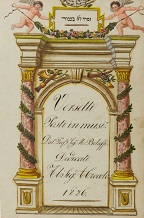
- “Verses set to music by various professors” (2 vols., 1825–1826), dedicated to the tenor Aron Crocolo.
- 18 “Sacred Songs for Days of Penance and Feast Days,” compiled by Ernesto Ventura.
- 15 “Sacred Songs” to be sung on Shabbat, part of a collection of songs by various authors titled “Sabato – Musica sacra”, transcribed in treble clef by Ernesto Ventura.
- 103 “Sacred Songs” for soprano, tenor, and bass, divided into two volumes titled “Musica sacra di Livorno”, ridotta da Moisè Ventura (arranged by Moisè Ventura).
- 125 “Psalms” for soprano, bass, soloist, and choir.
- “Simhat Mitzvah”: a religious drama in two acts, with a libretto by Daniele Terni (the music is not available)
Instrumental compositions: “Suonata prima per cimbalo a piano-forte”…
- “Suonata prima per cimbalo a piano-forte”: with accompaniment by a mandolin or violin.
- “Armonia lugubre sentimentale,” Opus V: for wind instruments, in memory of Cimarosa.
- “Armonia lugubre”: piano sonata, in memory of Cimarosa.
Music history and theory writings
As a music historian, Bolaffi wrote the “Dissertation on Modern Music Compared to Ancient Music,” a fourteen-page treatise in which, through a meticulous analysis of music history, he presents his original reflections on its evolution. The final section of the “Dissertation” is particularly interesting, as it outlines a plan for reforming music schools, education, and the theater.
As a theorist, he composed the “Principles of Music in Octaves,” accompanied by a table of examples (published in Florence by Giuseppe Lorenzi), as well as a fifteen-page treatise containing musical examples titled “Reasoned Compendium of the Principles of Music for the Use of Older Students.” Finally, a philosophical reflection on human existence, art, and music appears in the pamphlet “Alcune mie idee sul gusto del secolo presente,” printed in Livorno in 1830.
Source and Bibliography:
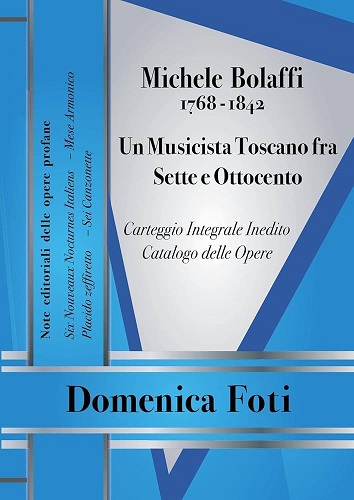
Domenica Foti, Michele Bolaffi (1768 – 1842. Un musicista toscano fra Sette e Ottocento. Tricase (Lecce), Youcanprint, 2022
Read David Conway’s article on Academia: “On Michele Bolaffi, an Itinerant Jewish Musician”
| 1 | According to Hervé Roten, the melody of this psalm is identical to the one sung in the Comtat Venaissin in the late 19th century. See the collection by Jules Salomon and Mardochée Crémieu, *Chants hébraïques suivant le rite des communautés israélites de l’ancien Comtat Venaissin* (1885), p. 169. |
|---|