The Moroccan Nightingale
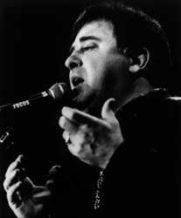
Born in Rabat, Morocco in 1952, Emile Zrihan (sometimes written “Zrihen”) was introduced to Jewish liturgical chant and Moroccan folk music at an early age. He emigrated to Israel with his family in 1963, and continued his studies of Chazanut (synagogal singing), learning, among other things, the music of the piyutim from Rabbi Shlomo Ouanounou. He showed a precocious talent for singing, and performed for the first time in concert at the age of 13. From then on, he was regularly featured for several years in the television programme “Folklore de l’Orient”.
With a remarkably powerful counter-tenor voice, he stirs the audience intensely during religious services, especially in the great synagogue of Ashkelon, where he is the resident cantor. A connoisseur of Arab-Andalusian and Oriental music, he sings in several musical registers, both sacred and secular, and performs the Arab, Arab-Andalusian and Judeo-Arabic repertoires. He excels in the art of the Mawwâl (sung improvisations, generally on the theme of love).
 His talent was revealed to the world at the 1997 World Music Expo in Berlin.
Emile Zrihan is a soloist with the Andalusian Orchestra of Israel and has performed extensively in Europe, North America and Israel.
Among the many albums on which he appears, let us highlight “Ashkelon” released in 1998 on the German label Piranha, “Andalousiya” on the Koliphone label, or the three volumes of his “Judeo-Moroccan Songs” on the NMC label.
Listen to the playlist dedicated to Emile Zrihan