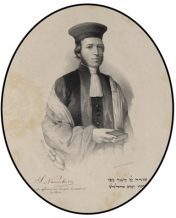
By Hervé Roten
Born on March 15, 1817 in Dennenlohe, in Bavaria, Samuel Naumbourg came from a long lineage of famous cantors. As he entered the synagogue at a very young age, he learned the cantorial art in South Germany. Later on, he studied singing and composition in Munich. He took part in the choir of the town’s new community, under the supervision of Maier Kohn.
A pioneer in ethnomusicology, he started to gather and to write an important part of the Ashkenazi oral tradition of South Germany.
Called to Strasbourg, he conducted the community’s choir from 1838 to 1843, and then in Besançon from 1843 to 1845.
 In 1845, he was appointed to the cantorship of the consistorial temple in Paris, with the recommandation of Fromental Halévy, and a trial period of one year. Samuel Naumbourg wanted to return the pomp divine service that it deserved. He started to reform a choir that he led with success, and for which he composed new tunes.
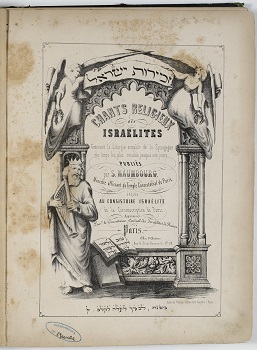
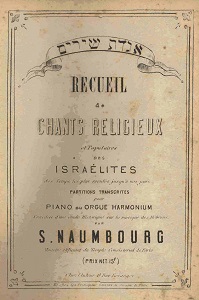
Between 1847 and 1874, Naumbourg published four synagogal music collection books for soloist, choir, and sometimes accompaniment of the harp, the piano or the organ (Zemirot Israel, Religious Songs of the Israelites, vol. I-II, 1847 ; Zemirot Israel, Religious Songs of the Israelites, vol. III, 1857 ; Chirei Kodech, New Religious Collection for the Jewish Cult, 1864 ; Agoudat chirim, Collection of Religious and Popular Jewish Songs, 1874). These collections comprise mainly his own compositions, but also arrangements of traditional tunes and other composers works (Lovy, Fromental Halévy, Alkan …).
 In 1860, Naumbourg was appointed liturgical singing teacher at the Jewish Seminary. In 1865, after the passing away of Cantor Isaac David, he became first cantor. He kept this position until summer 1878 when he fell deeply sick, which kept him away from the synagogue until his death, 18 months later, the 1st of May 1880. Samuel Naumbourg was buried in the Parisian cemetary of South-Montparnasse.
*Excerpt from Hervé Roten’s article, « The musical heritage of the Great Synagogue of La Victoire », La synagogue de la Victoire, 150 ans du judaïsme français, éditions Porte-plume, 2017
Yigdal, Passover Evening Service – Samuel Naumbourg